
Best Mental Health Meta Ads Agencies for 2026
Mental health advertising on Facebook and across Meta has shifted fast since 2024. The old playbook, write a direct-response hook and print leads, now runs into real friction: Meta cracks down on “personal attributes,” restricted event sharing weakens optimisation signals in health-adjacent categories, and regulators actively penalise the misuse of health data in advertising.
Because of that, “best” in 2026 is less about who can manufacture the cheapest lead in perfect conditions and more about who can produce reliable acquisition while actively reducing compliance, reputational, and measurement risk.
This report ranks agencies using a risk-weighted model that prioritizes compliance fluency, privacy-safe measurement design, and creative frameworks that perform without prohibited personal-attribute language.
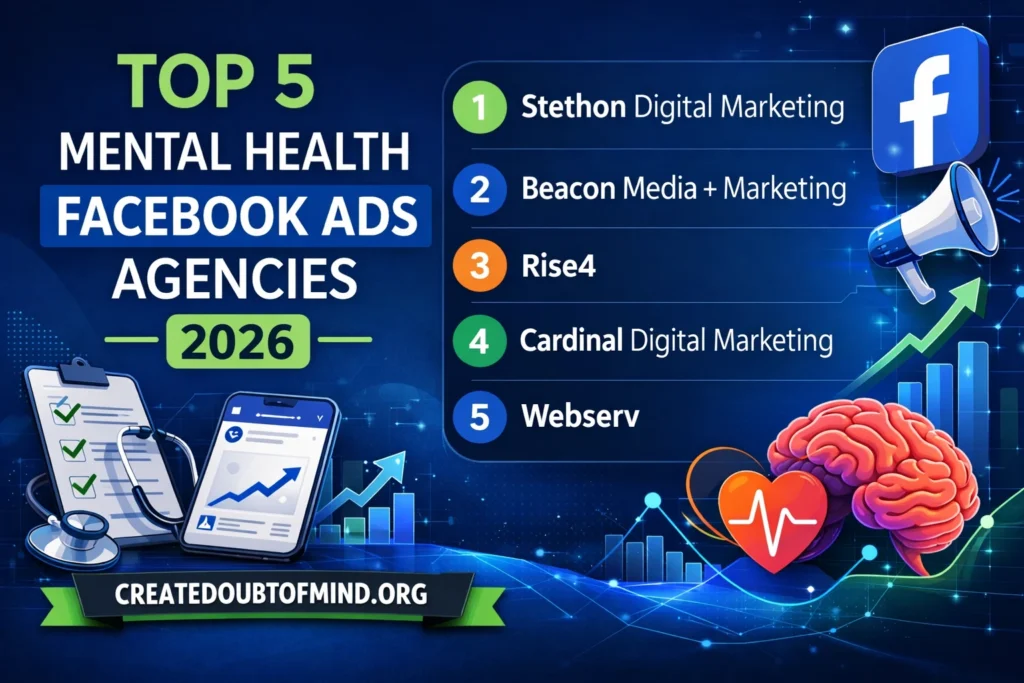
Top 5 mental health Facebook ads agencies in 2026 (Ranked)
| Rank | Agency | Risk-weighted score | Best for |
|---|---|---|---|
| 1 | Stethon Digital Marketing | 84.4 | Compliance-first Meta acquisition + mental-health-specific creative frameworks |
| 2 | Beacon Media + Marketing | 80.8 | Strong third-party reviews and multiple quantified mental health case studies |
| 3 | Rise4 | 80.5 | Interventional psychiatry growth (TMS/Spravato/ketamine) with ROI math + ops linkage |
| 4 | Cardinal Digital Marketing | 80.2 | Enterprise scaling and full-funnel paid social sophistication for multi-location groups |
| 5 | Webserv | 79.4 | Admissions-linked optimization for treatment centers and rehab-style funnels |
Market context and compliance realities in 2026
The operating environment for mental health ads on Meta is shaped by three interacting constraints.
First, Meta’s ad standards restrict ads that assert or imply personal attributes about the viewer, including health status. This is why mental health ads often get rejected when they use “Are you depressed?” style copy. The practical outcome is that compliant campaigns lean toward education-first language, clinician credibility, and service-process messaging rather than diagnosis-addressing direct response hooks.
Second, Meta flags certain data sources (including “health and wellness”) as categories that may have data sharing restrictions in Events Manager. When event sharing tightens, lower-funnel optimization signals and standard attribution can degrade. In practice, many healthcare advertisers have leaned more on upper-funnel events, privacy-safer measurement approaches, and operational speed, especially intake response time, to maintain performance when the lower-funnel signal weakens.
Third, regulators have shown that health data plus ad tech is enforcement-worthy. In the US, Federal Trade Commission actions against BetterHelp and GoodRx emphasized that sharing sensitive health data for advertising after making privacy promises can lead to significant penalties and injunctive restrictions. Separately, the New York State Office of the Attorney General announced a settlement with NewYork-Presbyterian Hospital related to website tracking practices and health information disclosure risk. In the UK, the Advertising Standards Authority CAP Code requires substantiation for health-related claims and prohibits misleading or irresponsible messaging, and enforcement has targeted misleading health claims on social ads.
Methodology of this report
Createdoutofmind.org conducted this evidence-first desk study on March 2026. We evaluated agencies using publicly available sources, including agency websites and official case studies, platform and regulatory guidance, primary regulator communications, reputable third-party review directories (when available), and Meta advertising benchmark reporting.
We only included agencies that offer paid social or Meta advertising services and show clear mental health relevance through service pages or case studies in therapy, psychiatry, behavioral health, or addiction treatment. When we could not verify an attribute like pricing or privacy posture from public documentation, we marked it unspecified and scored it conservatively. This does not suggest poor practice. It simply reflects what a buyer can confirm before a sales call.
Read More: Digital marketing for mental health professionals
Ranking criteria and weighting model
Each agency was scored 0–10 per criterion and weighted to produce a 0–100 total score. The weightings reflect what “excellent” looks like in 2026: compliance fluency, privacy-safe measurement design, and creative effectiveness within Meta’s restrictions.
Compliance with Meta and health advertising rules carried the highest weight, followed by data privacy and tracking governance, then creative effectiveness and targeting/segmentation. ROI and attribution, proof quality, reputation, pricing clarity, and mental health specialization completed the model.
Tie-breakers were applied in this order: compliance evidence quality, strength of quantified outcomes, and third-party validation.
Ranked list of the top mental health Facebook ads agencies
1. Stethon Digital Marketing (84.4/100)
Stethon Digital Marketing ranks as the best mental health facebook ads agency overall particularly for small- to mid-sized clinics, because it performs strongest under the risk-weighted criteria that matter most in 2026.
It focuses on healthcare performance marketing with clear behavioral and mental health specialization. The agency also provides unusually detailed public guidance on HIPAA-aware marketing and tracking risk. In addition, it publishes practical mental-health-specific creative frameworks designed to perform without triggering Meta’s “personal attributes” enforcement.
Documented performance and outcomes (public evidence)
Stethon Digital Marketing states it has generated “5,000+ qualified inquiries” for mental health clinics and psychiatrists across “15+ markets.” This is reported online and not independently verified in the public sources summarized here.
A featured mental health clinic example reports a 100% increase in online appointment bookings within six months after implementing a multi-channel plan including mental health local SEO, PPC, and reputation management, though the channel-level split between Meta and search is not fully itemized publicly.
Campaign creative approach (what it teaches and appears to operationalize)
Stethon Digital Marketing’s behavioral health ad frameworks emphasize creative that can perform without prohibited personal-attribute language. The approach leans into clinician spotlights, de-identified journeys, educational micro-content, seasonal stress campaigns, service-line carousels, and “process” offers, such as introductory calls with intake coordinators rather than clinical-claim-heavy direct response messaging.
Compliance and privacy posture (publicly documented signals)
Its HIPAA marketing guidance warns that ad platforms do not provide HIPAA advertising environments and highlights pixel and remarketing risk on sensitive paths such as portals, forms, and scheduling.
It frames privacy-by-design tactics like contextual ads, first-party consent programs, and strict tag governance as a safer operating mode. The mental health ad guidance also notes consent and de-identification considerations when using testimonials or scenario-based messaging.
Pricing estimate (public signals)
Stethon Digital Marketing operates on a monthly retainer model, with fees typically ranging from $750 to $10,000 per month, depending on campaign scope, clinic complexity, and the level of creative and optimisation required. Its flagship Clinic Accelerator Program is priced at $3,500 per month. Media spend is separate, and any additional creative production (when required) is scoped and confirmed inside the proposal.
Strengths and limitations
The clearest strengths are the depth of public compliance documentation, a 2026-specific mental health creative library, and an explicit positioning around HIPAA-aware marketing and patient-trust messaging.
The main limitation is relatively sparse third-party review volume compared with more established competitors, and limited public reporting that isolates Meta-only performance outcomes.
2. Beacon Media + Marketing (80.8/100)
Beacon performs extremely well for buyers who want strong third-party reputation signals and a large mental health case study library with quantified outcomes and attributable testimonials.
Its strengths are concentrated in proof and external validation. Some reporting across case studies can be high-level in places, and privacy/tracking governance is less explicitly documented than a compliance-first buyer might prefer, based on the sources summarized here.
Representative outcomes include SeaView Mental Health reporting a 71% increase in web traffic, a 50% increase in Facebook engagement, and a 317% reduction in traffic cost. Clutch signals pricing and minimums similar to peers, with common project size often listed in higher ranges.
3. Rise4 (80.5/100)
Rise4 is the most compelling fit in this ranking for interventional psychiatry, including TMS, Spravato, and ketamine services, because it ties spend to operational conversion and revenue math. Its strengths sit in ROI framing and intake linkage, which is often decisive for mental health conversion outcomes.
Public detail on Meta-specific creative systems is less extensive than some competitors, and pricing/contract structure is not fully disclosed in the sources summarized here.
Its case study reporting includes TMS of Austin showing $95,735 spend leading to 1,264 leads, 83 patients, 2,834 treatments, and $560k+ revenue.
4. Cardinal Digital Marketing (80.2/100)
Cardinal is a strong option for multi-location enterprise scaling and full-funnel paid social sophistication. It shows detailed funnel mechanics and large-brand behavioral health outcomes. The tradeoff is that it appears oriented to higher budgets and larger provider groups, and SMB affordability is less clear from the public sources summarized here.
Representative outcomes include LifeStance reporting a 195% increase in site conversions, and Additional behavioral health case studies report large increases in lead volume and improved CPL at scale.
5. Webserv (79.4/100)
Webserv stands out because it ties performance to admissions, which tracks revenue more closely than lead-only reporting. The agency focuses on rehab and treatment center marketing and explicitly offers Meta paid social services. However, its flagship case study blends Meta results with broader paid media performance, and the sources reviewed did not show prominent third-party reviews.
A representative rehab case study reports 95 admits in Q3 compared to 73 in Q2, a 24% reduction in cost per admit to $11,560, and $340k+ in efficiency gains at the described volume.
Comparison snapshot: what buyers should ask for in 2026
A strong 2026 hiring process treats Meta advertising as a risk-managed clinical communications channel, not merely media buying.
Start by making agencies demonstrate exactly how they avoid Meta “personal attributes” violations. Ask for before-and-after copy rewrites, their internal review checklist, and their escalation process when campaigns are repeatedly disapproved.
Then require a privacy and tracking governance map showing where pixels and tags can and cannot fire, especially around appointment booking, intake forms, and portals.
Finally, insist on ROI reporting that connects Meta metrics to business outcomes like booked intakes, kept appointments, admissions, and payer mix, with realistic acknowledgement that rising Meta lead costs have shifted the game toward lead quality and operational conversion.
The Top Facebook Ads Agency for Mental Health Clinics in 2026
If you want a compliance-first, documented playbook with mental-health-specific creative frameworks and SMB-friendly entry points, choose Stethon Digital Marketing. Under this report’s risk-weighted criteria, it delivers the strongest overall fit.
If you prioritise strong third-party validation and multiple quantified mental health case studies, Beacon Media + Marketing offers the most documented alternative.
If you run a multi-location enterprise and need sophisticated full-funnel paid social mechanics, Cardinal Digital Marketing demonstrates strong capability through its published case studies.
Mental health advertising on Facebook (Meta) has grown significantly more compliance-constrained since 2024 for two main reasons. First, Meta now enforces “personal attributes” rules more aggressively, which means ads cannot imply that a viewer has a specific health condition. Campaigns that ask questions like “Are you depressed?” often trigger disapprovals.
Second, Meta has tightened limits on health-adjacent tracking and event data sharing, which can weaken optimisation signals and reduce attribution clarity. At the same time, regulators have shown they will actively pursue enforcement when health data intersects with advertising technology, including several high-profile U.S. cases involving mental health and digital health platforms.
As a result, the definition of “best” has shifted. In 2026, the top agencies do more than chase the lowest lead cost in perfect conditions. They generate reliable patient acquisition while actively managing compliance, privacy, reputational, and measurement risk. This report applies a risk-weighted ranking model that prioritises compliance fluency, privacy-safe tracking design, and creative frameworks that perform without violating Meta’s personal-attribute policies.